
In the blue corner
Glazyr
Zero-copy browser perception infrastructure for AI agents
AI Agents & Infrastructure
Browser perception infrastructure that serves page state from shared memory with deterministic layout engine coordinates, designed to reduce token costs for AI
About Glazyr
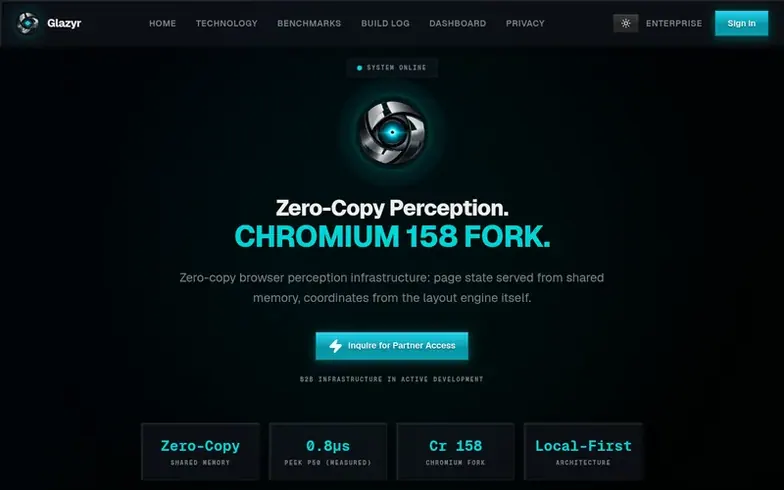
Glazyr is a zero-copy browser perception infrastructure layer for AI agents. It serves page state from shared memory rather than through traditional Chrome DevTools Protocol, achieving 50× faster state reads and 13-15× token reduction compared to standard approaches.
The system is built on a Chromium 158 fork that writes page-content trees directly into a 32MB shared memory region, where they can be read in 0.8 microseconds median latency. Agents connect through the Model Context Protocol (MCP) with nine core tools: status, navigate, peek, peek_raw, peek_subtree, find, click, type, and scroll.
Glazyr is currently available as a local-first workstation build requiring Linux x64 and Node 18+. It has been verified on identical tasks where it completed the same workflows with 8,775 tokens versus 114,737 tokens for raw Chrome DevTools Protocol and 130,993 tokens for Playwright MCP. The company is in active development and works with select B2B infrastructure partners.
Where it stands out
- Zero-copy shared memory with 32MB region for page state
- 0.8 microsecond median shared memory read latency
- Chromium 158 headless shell custom fork
- Deterministic layout engine coordinates for precise element targeting
- 9 core MCP tools for perception and action
- 3.7x to 5.4x token reduction versus CDP
- 28ms median MCP latency on large pages
- Summary-first navigation with heading outlines
- Semantic filtering preserves URLs and form field names
- Local-first workstation architecture
Pricing
Pricing model: Free
Questions
- Why did Glazyr create a Chromium fork instead of using a CDP sidecar?
- The team measured a CDP sidecar extracting page state over DevTools protocol and found it took 38.7ms median latency, exceeding their 25ms budget and scaling poorly with page node count. They also found that the fastest alternative layout engines fabricated element coordinates, disqualifying them for reliable actions. This led to the decision to build a thin Chromium fork whose compositor publishes state to shared memory.
- How much do token costs actually reduce with Glazyr?
- On a large Wikipedia article with 10,247 nodes, Glazyr reduces tokens from 57,108 (Chrome DevTools Protocol) to 15,343 at standard filtering (3.7x reduction) or 10,501 at aggressive filtering (5.4x reduction), while preserving all nine facts needed for the test tasks. Across three identical end-to-end tasks, Glazyr used 8,775 total tokens versus 114,737 for raw CDP (13x fewer) and 130,993 for Playwright MCP (15x fewer).
- What are the system requirements to run Glazyr?
- Glazyr requires Linux x64 and Node 18+. The browser bundle (approximately 106 MB) downloads automatically on the first run.
- How does Glazyr's MCP bridge connect AI agents to the browser?
- Glazyr ships as an MCP server with nine tools: status (check browser state), navigate (move to URL with summary), peek (filtered page state), peek_raw (unfiltered state), peek_subtree (zoom into element subtrees), find (search page structure), click (click by node ID with auto-scroll), type (direct text input), and scroll (viewport scrolling). The browser launches and manages itself; agents read curated state and act on node IDs.
Glazyr has a free listing. The owner can unlock the full profile with a paid launch for $5:
- Founder story (locked)
- Milestones (locked)
- Demo video (locked)
- Dofollow website link: not on this free listing (its website link is nofollow)